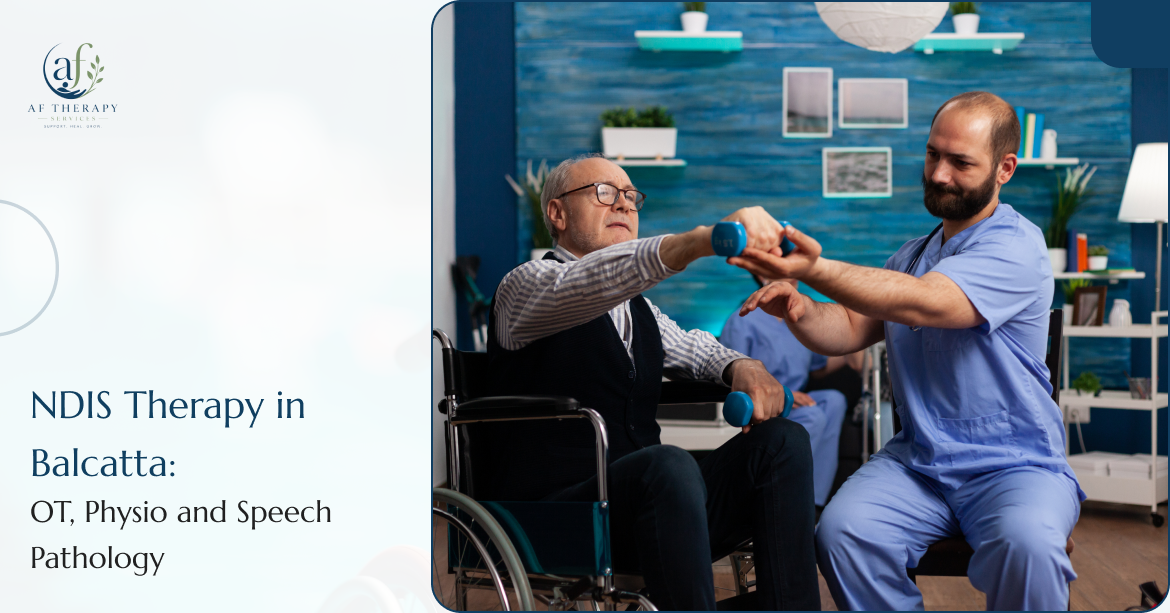
NDIS Therapy in Balcatta: OT, Physio and Speech Pathology
If you are looking for NDIS therapy in Balcatta, AF Therapy Services provides occupational therapy, physiotherapy and speech pathology (speech therapy) from one clinic at 283 Wanneroo Road, Balcatta, with an on-site heated hydrotherapy pool. Therapy is usually funded under the Capacity Building part of your NDIS plan, so you can use it with a plan-managed, self-managed or NDIA-managed plan. This guide explains what each therapy does, how it is funded, how to get started, and what to expect when you arrive.
What kinds of NDIS therapy can you get in Balcatta?
Allied health therapy helps you build skills, manage pain, move more easily and take part in daily life. The three most common therapies for NDIS participants are occupational therapy, physiotherapy and speech pathology. Having them in one place makes it easier to coordinate your care, because your therapists can share information and work towards the same goals.
| Therapy | What it helps with | Typical goals |
|---|---|---|
| Occupational therapy (OT) | Daily living skills, sensory needs, equipment, home and community access | Cook, dress, shower, manage routines, use equipment safely |
| Physiotherapy | Movement, strength, balance, pain and mobility | Walk further, reduce pain, prevent falls, build strength |
| Speech pathology | Communication, language, swallowing and social skills | Express needs, understand others, eat and drink safely |
AF Therapy Services also offers dietetics, exercise physiology, allied health assistant support and group therapy. You can read about each on our services page.
Occupational therapy in Balcatta
Occupational therapy focuses on the everyday tasks that matter to you. An OT looks at how you manage at home, at work or school and in the community, then works with you to build skills or change the way a task is done. This can include:
- assessments of daily living, sensory needs and independence;
- practising skills such as meal preparation, personal care and managing money;
- recommending equipment, home changes and assistive technology;
- reports and recommendations to support your NDIS plan.
For a deeper look, read our complete guide to NDIS occupational therapy, or visit the occupational therapy page.
Physiotherapy in Balcatta
Physiotherapy helps with movement, strength, balance and pain. For NDIS participants, a physiotherapist can build a program around your goals, whether that is walking more confidently, managing a long-term condition or recovering after an injury. Sessions may include exercises, hands-on treatment, mobility training and advice for carers and support workers.
Our physiotherapists can also work alongside our hydrotherapy pool, where warm water reduces the load on joints and makes movement easier. Learn more about physiotherapy and about physiotherapy funding and eligibility.
Speech pathology (speech therapy) in Balcatta
Speech pathology, also called speech therapy, supports communication and swallowing. A speech pathologist can help children and adults who have difficulty speaking, understanding language, using communication aids, making friends or eating and drinking safely. Support might include:
- speech sounds, language and social communication;
- communication devices and alternative ways to communicate;
- swallowing and mealtime safety;
- training for families, carers and support workers.
See our speech therapy page, or read about NDIS speech therapy for kids and adults.
Hydrotherapy: a heated pool on site
AF Therapy Services has an on-site heated 15-metre hydrotherapy pool. Water supports your body weight, which can make exercise easier and more comfortable, particularly if you have pain, stiffness or limited mobility. Hydrotherapy is often used alongside physiotherapy and exercise physiology. You can read more about NDIS hydrotherapy in Perth or the hydrotherapy service.
How is NDIS therapy funded?
Therapy is usually paid from the Capacity Building budget in your NDIS plan, commonly under Improved Daily Living. Your funding amount, and how many hours you have, are set in your plan. You can use therapy services with any plan management type:
- Plan managed: your plan manager pays our invoices.
- Self-managed: you pay and claim, or we invoice you directly.
- NDIA-managed: invoices are claimed through the NDIS with a registered provider.
Check your plan for Capacity Building funding before booking. If you are not sure how much therapy you have, your support coordinator or plan manager can help you find out. Our team can also explain what is funded when you contact us.
How to get started with therapy in Balcatta
- Check your plan. Look for Capacity Building funding that covers therapy.
- Decide which therapy you need. If you are not sure, ask us, or see the section below on choosing a therapist.
- Send a referral or enquiry. Use our referral page. Anyone can refer, including participants, family members, support coordinators and plan managers.
- We will contact you. We confirm what you need, discuss your goals and explain the next steps.
- Sign a service agreement. This sets out the supports, prices and how we will work together.
- Attend your first session. Your therapist will talk about your goals and how therapy can help.
What to expect at your first appointment
Your first session is mostly about getting to know you. Expect your therapist to:
- ask about your goals, your daily routine and what is hard right now;
- review any reports, assessments or your NDIS plan goals if you bring them;
- do a short assessment, which depends on the therapy;
- explain what a program might look like and how often you will attend;
- answer your questions and agree on the next steps with you.
It helps to bring your NDIS plan or a summary of your goals, a list of medications and any recent health reports. You are welcome to bring a family member, carer or support worker.
Who can benefit from therapy?
NDIS therapy is not limited to one age or one type of disability. Children, teenagers and adults can all benefit when therapy is matched to their goals. Common reasons people seek therapy include:
- developmental delay, autism or intellectual disability;
- cerebral palsy, brain injury or other neurological conditions;
- physical disability, chronic pain or reduced mobility;
- communication difficulties or swallowing problems;
- needing support to live more independently at home or in the community.
Your therapist will tailor the program to you, so sessions look different for each person. Goals are agreed with you, and progress is reviewed over time so that therapy continues to match what you need.
How to get the most from your NDIS therapy
Therapy works best when you, your family and your support team are all working towards the same goals. These simple habits make a real difference:
- Be clear about your goals. Think about what you want to be able to do in six months, and tell your therapist.
- Practice between sessions. Short, regular practice at home often matters more than the session itself.
- Involve your support network. Family, carers and support workers can help with exercises and routines when they know the plan.
- Share what is and is not working. Your therapist can change the program if something is too hard, too easy or not useful.
- Keep an eye on your budget. Ask your plan manager or support coordinator how much therapy funding remains, so you can plan sessions across the year.
- Plan for your review. Therapy reports can support your next NDIS plan review, so ask what your therapist can provide.
Which therapist do you need?
Many participants need more than one therapy, but here are some simple starting points:
- Trouble with daily tasks, sensory issues or equipment: start with occupational therapy.
- Pain, weakness, balance or mobility: start with physiotherapy.
- Difficulty communicating or swallowing: start with speech pathology.
If you are not sure, contact us and describe your situation. We can suggest where to start and whether more than one therapist should be involved.
Where is AF Therapy Services in Balcatta?
Our clinic is at 283 Wanneroo Road, Balcatta WA 6021, in Perth's northern suburbs. The location makes it convenient for people living in and around Balcatta and the surrounding northern corridor. Contact us if you would like help planning your visit or checking whether the location suits you.
- Address: 283 Wanneroo Road, Balcatta WA 6021
- Phone: (08) 6184 6736
- Email: info@aftherapyservices.com.au
Ready to start? Make a referral or contact AF Therapy Services and we will guide you through the next steps.
Frequently asked questions
Q1. What NDIS therapy is available in Balcatta?
AF Therapy Services provides occupational therapy, physiotherapy and speech pathology in Balcatta, along with dietetics, exercise physiology, allied health assistant support, group therapy and hydrotherapy.
Q2. Is therapy covered by the NDIS?
Therapy is usually funded from the Capacity Building part of your NDIS plan, commonly under Improved Daily Living. Check your plan to see how much funding you have.
Q3. Do I need a referral to see a therapist?
You can start by sending a referral or enquiry through our referral page. Participants, families, support coordinators and plan managers can all refer.
Q4. Can I use therapy with a plan-managed plan?
Yes. You can use therapy services with plan-managed, self-managed and NDIA-managed plans. Your plan manager pays our invoices if your plan is plan-managed.
Q5. What is the difference between speech therapy and speech pathology?
They mean the same thing. Speech pathology is the professional name, and speech therapy is the term many people use.
This article is general information, not medical advice. Speak to your health professional about your own situation, and check your NDIS plan for current funding rules.
Ready to get started? Make a Referral or Contact AF Therapy Services and we will guide you through the next steps, or call us on (08) 6184 6736.